How Old Norse names worked
A Norse name from the Viking Age was never just a label. It was a small sentence about who you were expected to be: a compound of meaningful words, a link to a god, or a memorial to a grandparent, followed by a patronymic that told everyone exactly whose child you were. This generator draws on a corpus of more than 160 given names attested in the sagas, in Landnamabok (Iceland's Book of Settlements), and on runestones, and it explains what each one means. This page covers how the naming system actually worked, so the names you pick carry the weight the originals did.
How Old Norse names were built
Most Old Norse given names are dithematic: two meaningful elements joined into one name. Learn a handful of elements and the whole corpus opens up. The prefix As- means "god" or "of the gods," so Asbjorn is the divine bear and Asgeir the spear of the gods. Thor- invokes the thunder god directly: Thorvald is Thor's ruler, Thorstein his stone, Thordis his goddess. On the second element, -bjorn is "bear," -ulf is "wolf," -hild and -gunn both mean "battle," and -rid (as in Astrid and Sigrid) descends from a word for "beautiful, beloved." Simple one-element names were common too: Bjorn, Ulf, Orm (serpent), and Hauk (hawk) were everyday names, not nicknames. Parents often honored a dead ancestor by reusing a name or one of its elements, which is why the same pieces echo through a family line across the sagas.
Patronymics: -son and -dottir
Norse society had no surnames. Identity came from your father (or, rarely, a famous mother): his name in the possessive form plus -son for a man or -dottir for a woman. Leif Eriksson was Leif, Erik's son; his sister was Freydis Eriksdottir. The patronymic changed every generation, so Leif's own son Thorkel would be Thorkel Leifsson, not Thorkel Eriksson. When you switch patronymics on, the generator follows exactly this rule, drawing from a pool of well-attested father names and always matching the ending to the gender of the given name. Iceland never abandoned the system: most Icelanders today still carry a true patronymic, which is why the phone book there sorts by first name.
How we know these names: the sagas and the stones
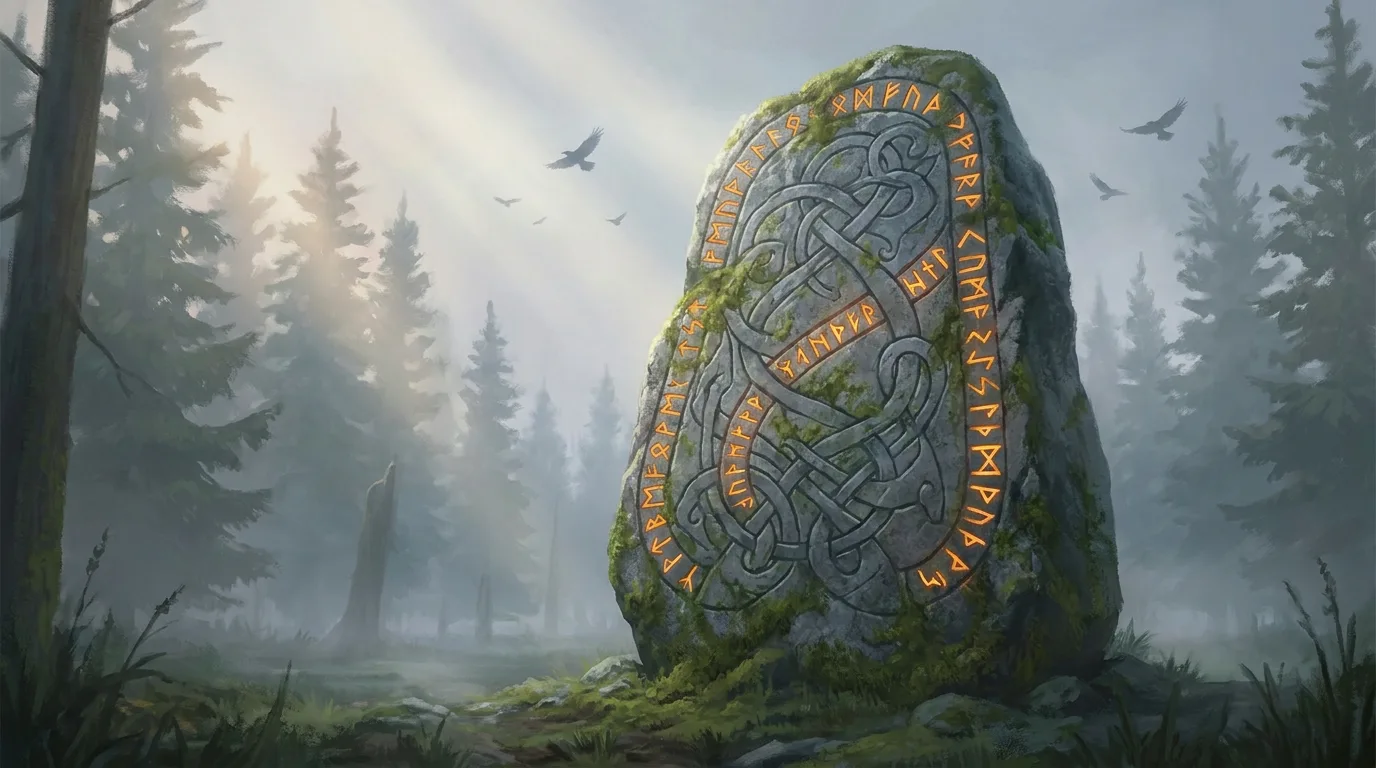
The evidence for real Viking Age names comes from three places. The Icelandic family sagas, written down in the 13th century, preserve the names of hundreds of settlers, farmers, poets, and feuding neighbors. Landnamabok records roughly 3,000 people who settled Iceland, name by name and farm by farm. And runestones across Scandinavia carry names carved by the people themselves, usually in a memorial formula: "X raised this stone in memory of Y, his father." The authentic corpus in this generator sticks to names with that kind of pedigree, with spellings normalized to plain ASCII so they are easy to type, search, and put on a character sheet.
Choosing the right style for your project
Writing historical fiction or running a saga-flavored campaign? Use the authentic style, and let the meanings do quiet work: naming a doomed character Hjordis (sword goddess) or a peacemaker Frode (wise) rewards the reader who looks it up. Building gods, demigods, or obviously mythic figures? The mythology style names the Aesir, the valkyries, and the norns; it reads as legendary rather than historical, which is exactly the point. Writing something contemporary, or naming a real-world project or a baby with Nordic roots? The modern Scandinavian style gives the forms in living use: Astrid, Freja, Espen, Torben. Genealogy hobbyists get a bonus from the patronymic engine: seeing how Eriksson and Eriksdottir are generated makes centuries-old Scandinavian church records suddenly legible.
Given names here, war names next door
One boundary worth knowing: this tool generates the names people were actually given, with their meanings and their patronymics. What it does not generate are the epithets and bynames the Viking Age bolted on afterward, such as Harald Fairhair, Eirik Bloodaxe, or Bjorn Ironside. Those were earned (or mockingly assigned) descriptions, a different layer of the naming system with its own conventions. If that battle register is what your raider, jarl, or shieldmaiden needs, our sibling Viking name generator is built for exactly that; pair an authentic given name from this page with an epithet from there and you have the full historical formula.